

The future arrived, brought a few AI agents with it, and then somehow made room for a 2,000-year-old poet.
Most books on Artificial Intelligence begin by explaining what AI is. Others attempt to predict where it is headed. A few oscillate between utopian promises and existential dread.
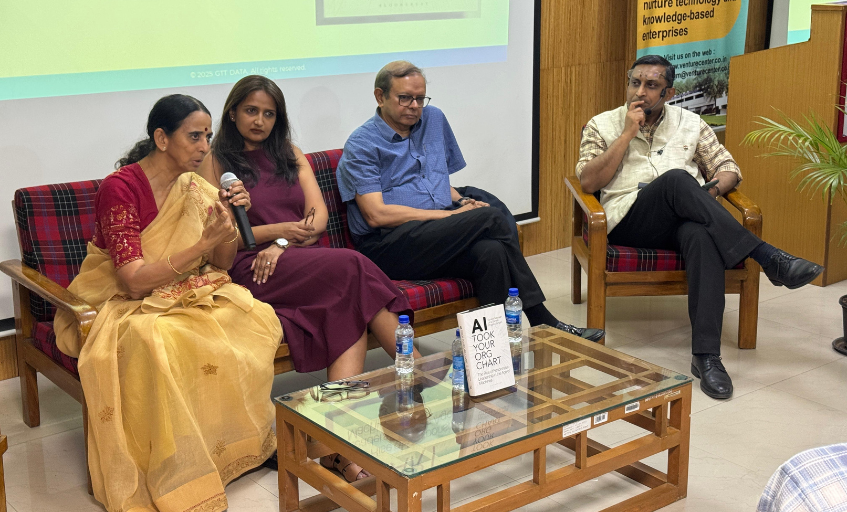
AI Took Your Org Chart, the latest book by Dr. Uma Ganesh, Dr. Ganesh Natarajan, and Priyanka Sangani, takes a different route. It begins with an assumption that many organizations are still grappling with: AI is no longer a future possibility waiting patiently at the door. It is already inside the building.
That assumption is embedded in the title itself.
Not AI Will Take Your Org Chart.
Not AI Might Take Your Org Chart.
AI Took Your Org Chart.
At Venture Center's recent Author Talk, Dr. Uma Ganesh explained that the choice of tense was deliberate. Borrowing the metaphor of a tsunami, she noted that AI has already washed over the village. The village has not vanished, but the shoreline has shifted. The landmarks may still be recognizable, yet the contours of the landscape have changed. Organizations, she suggested, are experiencing something similar. The org chart may still look familiar, but the logic of how work gets done is being fundamentally reshaped.

The Title Was Not Being Dramatic
The discussion made it clear that this is not a book about AI tools. Nor is it another attempt to forecast which jobs will disappear next. Instead, it examines AI through a leadership lens.
Dr. Ganesh Natarajan traced AI's evolution through the DIKW hierarchy—Data, Information, Knowledge, and Wisdom. The journey began with descriptive analytics that explained what happened, progressed through diagnostic and predictive systems, and eventually arrived at prescriptive models capable of recommending action.
The progression was mirrored in the evolution of digital businesses themselves. Early transformations were technology-led. Over time, organizations began creating integrated digital experiences. Netflix and Disney transformed how content was consumed. Uber reimagined urban mobility through platform thinking. Amazon moved from recommending products to anticipating customer needs, often before customers recognized them themselves.

Then came Generative AI.
Then Agentic AI.
Machines have had a remarkably impressive career trajectory. A few years ago they were helping people find information. Today they are generating content, recommending decisions, and increasingly acting on behalf of users.
As Dr. Natarajan observed, emerging AI agents are becoming goal-seeking, continuously learning systems capable of understanding preferences, coordinating with other agents, and making increasingly sophisticated recommendations. The progression from "People like you bought this" to "If I were you, I would do this" is no longer science fiction.
Reimagining, Not Retrofitting
One of the strongest themes emerging from the discussion was that AI's greatest value does not come from doing existing things faster. It comes from reimagining how things are done altogether.
The common thread across successful digital businesses was not automation. It was reinvention. Uber did not simply digitize taxis. Netflix did not merely improve DVD rentals. They redesigned the underlying business model itself.
The authors argued that AI presents a similar opportunity.
Organizations that treat AI as another software deployment may improve efficiency. Organizations that rethink how value is created may redefine entire industries.
The examples discussed during the session illustrated this vividly. Saudi Aramco's operations use AI to monitor nearly 200,000 industrial components and predict failures weeks before they occur. A fraud analytics function that once required hundreds of people can now be supported through multiple AI agents working together. Financial institutions are redesigning lending and claims processing through AI-driven personalization, while predictive healthcare systems are moving from reaction to anticipation.
Equally memorable was Dr. Natarajan's story about former IBM Chairperson Ginni Rometty. Asked about the purpose of AI, her response was not about replacement but capability transfer. The role of AI, she argued, is to transfer the knowledge and expertise of the very best to everyone else. In many ways, that idea sits at the heart of the book.
Priyanka Sangani added a practical perspective, noting that the AI era is already challenging assumptions about talent. Organizations are increasingly valuing professionals who are comfortable working alongside intelligent systems rather than competing against them. This was not presented as a story of replacement. It was presented as a story of reinvention.

When the Future Started Sounding Familiar
For all the discussion around analytics, agents, and organizational redesign, some of the most thought-provoking moments came from places one would least expect.
A Tamil epic.
A Bengali short story.
And a poet who lived more than two millennia ago.
Through the Thirukkural, Dr. Uma Ganesh highlighted ideas around thoughtful action, ethical leadership, and measured judgment. The surprise was not that these ideas appeared in an AI discussion. The surprise was how relevant they felt once they did.
The story of Kannagi and Kovalan from Silappadikaram became a lesson on justice. A ruler, convinced by what appeared to be compelling evidence, rushed to judgment and paid the price for it. In an age of dashboards, predictions, and AI-generated recommendations, the lesson remains remarkably current. Confidence is not proof. Data is not truth.
Tagore's Kabuliwala offered a different perspective. An algorithm may identify a migrant trader and summarize the plot flawlessly. Yet the emotional core of the story lies elsewhere—in a father's longing for his daughter. The data may be accurate. The meaning lives beneath it.

These stories ultimately led to one of the book's central ideas: Dual Intelligence.
Not Human Intelligence versus Artificial Intelligence.
Human Intelligence with Artificial Intelligence.
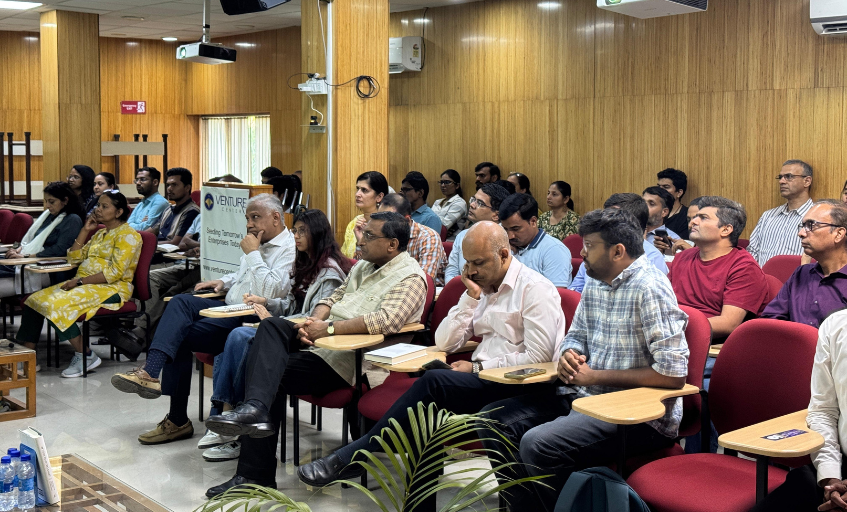
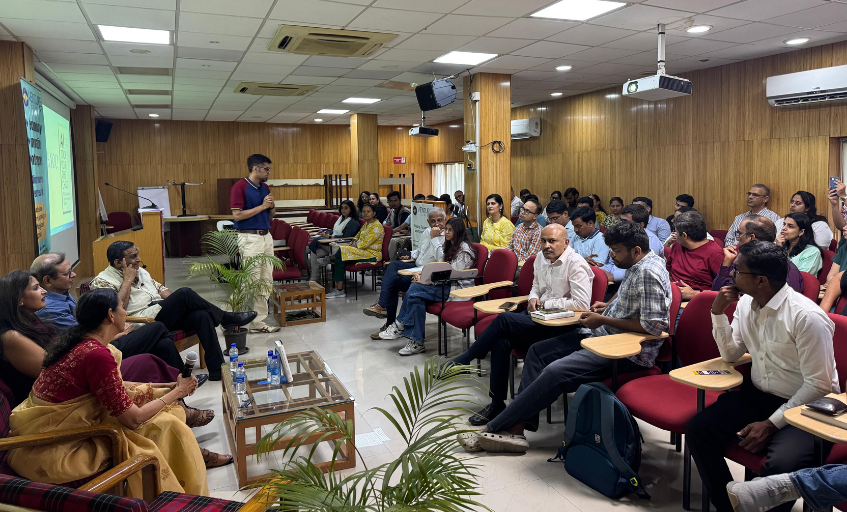
Throughout the evening, there was remarkably little anxiety about whether AI would become more capable. The speakers seemed to take that as a given. The greater uncertainty appeared to lie elsewhere.
For all the excitement surrounding Agentic AI, autonomous systems, predictive analytics, and increasingly intelligent machines, the discussion repeatedly returned to ideas that have occupied human beings for centuries: judgment, justice, empathy, responsibility, and wisdom.
Which is perhaps why Thiruvalluvar, Kannagi, and Kabuliwala felt so relevant in a room discussing Artificial Intelligence.
Not because they had anticipated AI.
But because they understood something about human beings that technology still struggles to explain.
The future envisioned by AI Took Your Org Chart is not one where humans compete with machines.
It is one where machines become extraordinarily good at what machines do, forcing humans to become far better at what only humans can do.
The real question is not whether AI will change the org chart.
It already has.
The question is: what will humans bring to the table when intelligence is no longer exclusively ours?
AI may be getting better at answering questions. That does not make asking better questions any less important.
If you would like to continue exploring ideas at the intersection of technology, leadership, innovation, and society, consider becoming a member of the Venture Center Library. Members enjoy access to a diverse collection of books, journals, and resources, along with a growing community of readers through the Venture Center Library WhatsApp group.
The library's catalogue is also available online through KOHA, making it easier than ever to discover, browse, and access resources from wherever curiosity happens to strike.
After all, the future may belong to Dual Intelligence—but lifelong learning still requires human initiative.