

Some conversations reveal connections you did not see coming.
At first glance, marketing and drug development belong to entirely different worlds. One moves at the speed of memes and viral moments. The other unfolds through years of experiments, clinical trials, and regulatory review.
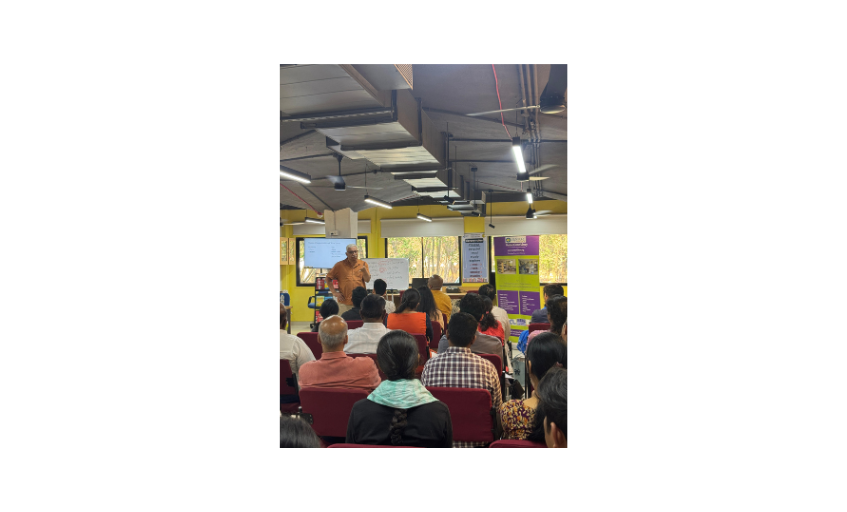
Yet a recent Venture Center Journal Club brought these two worlds into the same conversation.
The session brought together two perspectives. Jagadish Bennale explored how brands respond to cultural moments in real time, while Dr. Narendra Chirmule reflected on how organizational culture shapes decisions inside pharmaceutical R&D.

As the conversation moved forward, a common theme began to surface: both fields require navigating complex systems where timing, judgment, and structure matter deeply.
Reading Culture in Real Time
Jagadish began with a simple observation: culture often moves faster than marketing plans.
For decades, advertising campaigns were carefully developed months in advance. But today cultural moments unfold almost instantly. A sporting event, a social media post, or an unexpected incident can trigger a global conversation within minutes.
This shift has given rise to what marketers call fastvertising — responding to cultural moments while people are still talking about them.
One example helped anchor the idea. During the 2013 Super Bowl blackout, Oreo posted a simple tweet: “You can still dunk in the dark.”
What made the moment memorable was not the tweet itself. It was the timing.
As the discussion progressed, the point became clearer: when brands respond in real time, audiences sense that the brand is paying attention. For a brief moment, the brand stops feeling like a distant institution operating behind ornate mohogany walls and instead feels present in the same cultural conversation.

When the Internet Rewrites the Story
But cultural conversations rarely unfold exactly as brands expect.
The discussion then turned to moments where cultural reactions took an unexpected direction.
The Peloton holiday advertisement from 2019 appeared to tell a simple story: a husband gifts his wife a Peloton bike and she documents her fitness journey over the following year.
But audiences interpreted it differently. The woman already appeared fit, and her slightly anxious expressions quickly turned the advertisement into a widely debated moment online.
Soon after, Aviation Gin released a short video featuring the same actress raising a martini to “new beginnings.” The brand never mentioned Peloton directly. By that point, the cultural narrative had already taken shape.
The example illustrated how brands do not always control the story — culture often does.
The Power of Subtlety
Several examples reinforced another insight: sometimes the most effective responses are the simplest.
When the wrong envelope was announced at the 2017 Oscars, briefly declaring La La Land the Best Picture winner instead of Moonlight, eyewear retailer Specsavers quickly posted: “Should’ve gone to Specsavers.”
Similarly, when fans discovered that cloaks in Game of Thrones were made from IKEA rugs, the company responded with a playful guide showing how to recreate the look.
In both cases the humour worked because the message was brief and trusted audiences to understand the reference.

When Brands Join the Conversation — and Get It Wrong
Speed, however, does not always lead to success.
One widely criticized example involved Pepsi’s Kendall Jenner advertisement, released during the Black Lives Matter protests. The commercial depicted a protest resolved by handing a can of Pepsi to a police officer, a message many viewers felt trivialized a serious social movement.
Other campaigns misread the tone of the moment as well. Kenneth Cole once referenced protests in Cairo while promoting a clothing line, while Gap encouraged online shopping during Hurricane Sandy.
The discussion returned repeatedly to one point: judgment matters more than speed.
Another risk is over-explaining the joke. Cultural references work best when audiences feel they are already “in on it.” The more a brand tries to spell out the moment, the more the humour disappears.
The Brand as the Butt of the Joke
Sometimes the smartest response is humility.
When supply chain issues left many KFC outlets in the United Kingdom temporarily without chicken, the company released a newspaper advertisement showing its bucket rearranged to read “FCK.”
Below it appeared the line: “A chicken restaurant without any chicken. It is not ideal.”
Instead of defending itself, the brand acknowledged the absurdity of the situation — and audiences appreciated the honesty.
AI Can Write the Copy. It Cannot Read the Room.
Generative AI is now making it easier than ever to produce marketing content quickly.
But speed alone does not solve the real challenge. There is a growing tendency to assume that once AI enters the room, the human effort behind creative work becomes less significant — as though good ideas now appear automatically from a well-written prompt and a slightly overconfident keyboard.
AI may accelerate production. It cannot judge whether the moment deserves a response in the first place.
That instinct still belongs to people.
Inside the Engine of Drug Development
If marketing operates at the speed of culture, drug development moves at a very different pace.
Dr. Narendra Chirmule, an immunologist who has held leadership roles at Merck, Amgen, and Biocon, spoke about how culture shapes decision-making inside pharmaceutical organizations. Bringing a therapy to market can take 10–15 years, and most candidates fail somewhere along the way. Scientific discovery is only the beginning; promising ideas must pass through research, clinical trials, regulatory review, manufacturing, and commercialization — each handled by specialized teams working together.

He began with a simple question: what does “culture” mean inside an organization? As ideas surfaced — leadership, trust, communication — it became clear that culture quietly shapes how scientific decisions move through institutions.

Drawing from his experience as R&D Head at Biocon, he described how organizational structures can influence innovation. At one point, he experimented with what he described as “flipping the structure by 90 degrees” — rethinking traditional hierarchies so that decisions could move more directly between teams rather than traveling slowly up and down rigid reporting lines.
To illustrate this, he shared a scenario. A scientist had to prioritize between two molecules — Insulin or Trastuzumab. Instead of deciding immediately, the question moved upward through several layers of management before eventually returning to the scientist who had raised it.

The example highlighted a familiar problem: clarity does not always come from hierarchy. Often the people closest to the science already understand the trade-offs involved.
Leadership, he emphasized, plays a crucial role in designing systems where communication flows smoothly and decisions do not become trapped between layers.
Rhythm, Voice, and Leadership
Dr. Chirmule concluded on a different note: how to speak.
Scientific insight alone does not move ideas forward. Communicating clearly — choosing the right tone, pace, and emphasis — often determines whether a message gains traction.
Drawing from his interest in Indian classical music, where he also plays the flute, he offered a simple analogy. A musician must understand rhythm and timing — knowing when to hold a note, when to pause, and how to guide listeners through a performance.
Leadership inside organizations, he suggested, requires much the same awareness.

Two Worlds, One System
By the end of the evening, the connection between the two discussions had become clearer.
Marketing requires understanding the complex ecosystem of culture. Drug development requires navigating the equally intricate systems of biology, regulation, and organizational decision-making.
The timelines may differ dramatically. The challenge is the same. Both demand systems thinking — the ability to observe patterns, interpret signals, and decide when to act.
And sometimes the most valuable insights emerge when two very different ways of thinking share the same room.
Curious about conversations where marketing, science, and unexpected ideas meet ?
Become a member of the Venture Center Library and join our WhatsApp community to stay part of the discussion.