

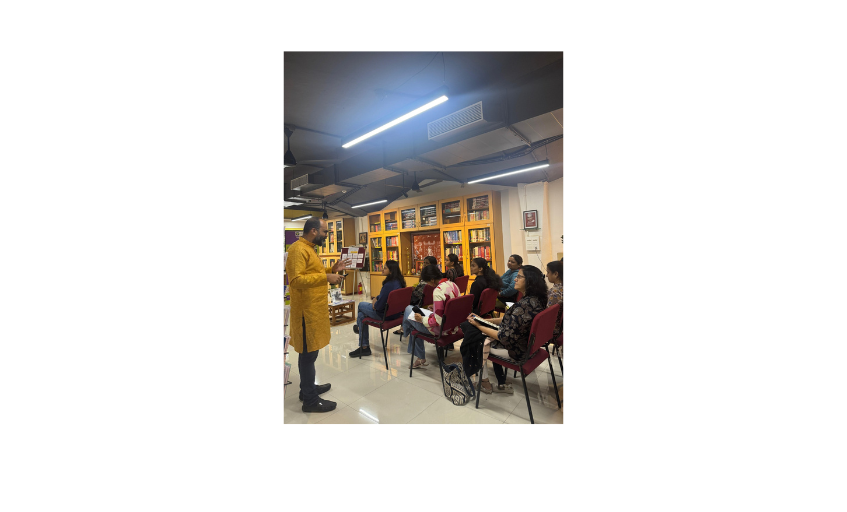
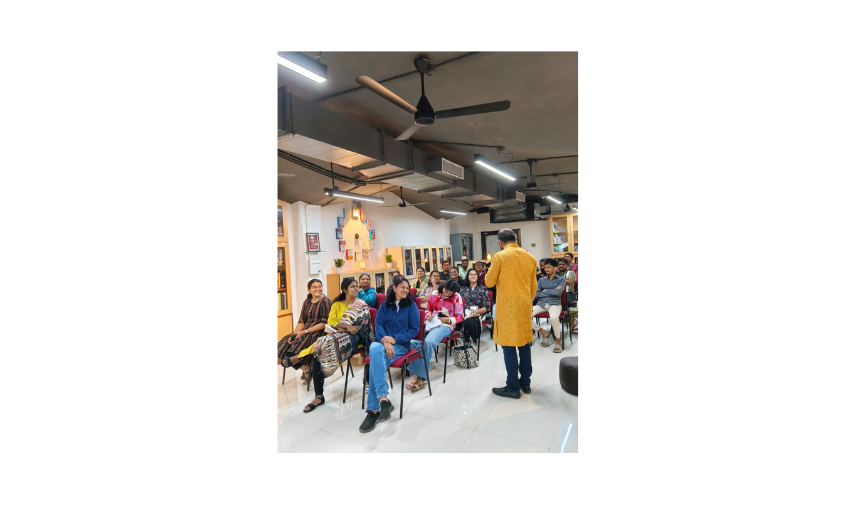
This Journal Club began with women’s career experiences—not as isolated stories, but as patterns that reveal how work actually unfolds. The conversation gradually widened to examine how experience is built, who gains access to formative roles, and how organisational design shapes long-term growth. What emerged was a discussion that connected individual journeys to the systems around them.

What Careers Reveal About Work, Strategy, and the Systems Around Us
Careers—especially women’s careers—rarely unfold the way they are planned. They are shaped as much by timing, access, and context as by ambition or effort. Progress is often non-linear. Pauses appear where momentum was expected. And many decisions are made not because of lack of capability, but because of the conditions surrounding it.
This was the starting point of the third Journal Club at Venture Center. The first article under discussion, How Women Can Win in the Workplace, provided a useful lens to examine these realities—not by focusing on confidence or motivation, but by asking a more structural question: what actually enables careers to grow over time?
Before the conversation widened to systems and strategy, it paused at a career that quietly embodied many of these ideas.
Jagadish Bennale opened the session by speaking about his mentor, Prof. M. A. Vijayalakshmi. A world-renowned Bioseparations Specialist from Tamil Nadu, whose career spans high-impact research, leadership, and mentorship. Based at VIT, her work has centred on separation sciences, protein purification, and biomolecular interactions—fields critical to both fundamental biology and applied biotechnology. Over decades, she has founded and led research centres, built advanced laboratories, supervised large academic teams, and mentored generations of scientists across disciplines and geographies.
Her relevance to the discussion was not symbolic. Her career offered a concrete example of what the article was pointing toward: when capability is matched with access, trust, and continuity, experience compounds. In professional ecosystems where women’s careers often slow or fragment mid-way, her trajectory demonstrated what sustained alignment can make possible.
Women’s careers, as they are actually lived
Women in the room spoke candidly about the misalignment between the biological clock and the career clock—two timelines that rarely move together, yet quietly shape decisions around risk, mobility, and leadership. Others reflected on self-doubt that persists even after competence is established, and on perfectionism that raises the threshold for action rather than improving outcomes.
These experiences were not framed as personal shortcomings. They were recognised as patterned responses to systems that reward uninterrupted progression and penalise pauses or deviation. While these dynamics surfaced most clearly through women’s experiences, many participants noted that they reveal deeper structural expectations about what a “successful” career should look like.
This is where the article’s central idea resonated strongly: career progress is driven less by potential than by accumulated experience.

Experience capital: bold moves, skill distance, and access
The conversation turned to experience capital—how it is built, and who gets access to it.
Participants spoke about the importance of bridging the skill distance—not through additional credentials alone, but through exposure to ambiguity, decision-making, and responsibility. Often, the gap is not one of ability, but of opportunity.
The idea of bold moves also surfaced repeatedly. Lateral shifts, stepping into unfamiliar roles, or taking on responsibility before feeling fully ready were recognised as critical accelerators. Confidence, many agreed, tends to follow action, not precede it.
A particularly resonant theme was access to power alleys—roles close to revenue, customers, and strategic decision-making. These spaces build credibility quickly and allow experience to compound faster. Yet women are still less likely to be encouraged into them early, shaping long-term leadership readiness.
Leadership entered the conversation here as responsibility rather than authority. Empathy was discussed not as a soft expectation placed on women, but as a leadership capability that enables trust, continuity, and real performance—especially in complex environments.
Only after these patterns were clearly surfaced did the discussion widen to the second article, The Power of Strategic Fit.

Strategic fit: the system behind the stories
Strategic fit shifted the lens from individual careers to organisational design. Its core idea—that strong strategies work because their parts pull in the same direction—helped explain why the same career patterns repeat across organisations.
What became clear was that strategic fit is not a women’s issue. It is a system issue. Misalignment between purpose, culture, leadership behaviour, incentives, and role design shows up first in people’s careers—often in women’s, but eventually in everyone’s.
Translating intent into practice requires cultural evolution, not policy alone. While women in leadership play a role in opening pathways, responsibility cannot rest with women alone. Men must feel equally accountable for shaping systems where experience is allowed to compound rather than stall
What the discussion ultimately surfaced
By the end of the Journal Club, a clear pattern had emerged.
Careers do not slow because of lack of effort or ambition. They slow when experience is delayed, when access to formative roles is uneven, and when organisations expect readiness before granting responsibility. Women’s careers made these dynamics visible early, but the mechanisms themselves were systemic.
The first article clarified what enables careers to move forward: accumulated experience, proximity to decision-making, and the willingness to allow learning in role. Concepts such as bold moves, bridging skill distance through exposure, and access to power alleys reframed growth as something that must be designed, not left to chance.
The second article explained why these patterns persist. Strategic fit determines whether experience compounds or stalls. When systems are misaligned, careers absorb the friction long before strategy fails on paper.
That intersection—between lived career experience and organisational design—is where meaningful change begins.

Understanding work requires more than quick answers. The Venture Center Library supports slow thinking, careful reading, and conversations that examine how systems shape careers. To become a member click here
You can join our WhatsApp community to stay updated here