

Venture Center’s 2nd Journal Club began with two incisive HBR papers on the table — one unpacking how generative AI is transforming work, the other exploring how it is reshaping brand identity. What unfolded was not a technical debate, but a deeper realisation: AI does not replace human judgment; it expands the power of it. This blog traces how that insight guided the conversation and where it led us next.

"Over the next decade, AI won't replace managers - but managers who use AI will replace those who don’t. "
That line echoed through the Venture Center Library as we gathered for our second Journal Club. It instantly brought back a memory of the first session—where we traced the threads of innovation, challenged assumptions, and turned a quiet corner of the library into a space alive with curiosity. This time, the atmosphere felt different. The conversation wasn’t about the future anymore. It was about the present. AI wasn’t approaching; it had already arrived.
When Work Turns into a Dialogue with AI
The discussion opened with a familiar question: How many of us shift between different AI tools depending on what we need? Almost everyone nodded. Some preferred one model for structure, another for creativity, and a different one altogether for fact-checking. It was a small reminder of how naturally AI has woven itself into our workflow.
And yet, this everyday behavior reflects something deeper from the article Embracing GenAI at Work: AI isn’t only “assisting” work; it is changing how work unfolds. But the shift becomes meaningful only when we don’t settle for a first draft. The group quickly agreed that the real magic lies in iteration—nudging the AI, refining context, adjusting tone, and slowly “teaching” the model what we actually expect.

That instinct—of refining outputs with clarity and persistence—brought us to prompt engineering. We often assume prompts are simple instructions. But the discussion made it clear: the difference between an average output and a sharp, aligned, almost intuitive one comes from how well a prompt is framed. Good users tell AI what to do. Great users tell it how to think.
At the same time, there was an honest acknowledgment of trust. To work with AI effectively, we need to rely on it. But we also need to verify, cross-check, and stay alert. Trust, in this landscape, isn’t blind—it’s informed.
Brands, Identity, and What AI Reveals
The conversation shifted from tasks to identity, guided by the article How AI Can Power Brand Management. A brand isn’t what an organisation says about itself; it’s the meaning people form through every interaction. With that in mind, AI doesn’t create identity—it reveals perception.
Nike offered a striking example of how this works in practice. When the company wanted to reinterpret its iconic Air Max line, it partnered with Obvious, the Paris-based collective known for using AI in creative work. Obvious trained a generative model on classic Air Max silhouettes — the 1, 90, and 97 — and refined the outputs repeatedly until they felt innovative yet unmistakably Nike.
The insight that stayed with the group was simple. AI expanded the space of possibilities, but human judgment guided every meaningful decision. Designers determined what aligned with the brand’s performance-driven identity, what honoured the legacy of the AIR models, and what was merely novelty. The collaboration reflected the article’s core message: AI strengthens a brand when it amplifies truth, not when it produces noise.
For young ventures, this example felt particularly relevant. AI offers early-stage teams the ability to understand their audiences at depth and at scale — a capability that was once the privilege of global companies.

Where the Threads Converge
By the end of the discussion, a single idea connected both articles. AI is neither a shortcut nor a threat. It is a mirror. It reflects our clarity, our habits, and our expectations. Used deliberately, it expands what we can do. Used passively, it simply mirrors our gaps.
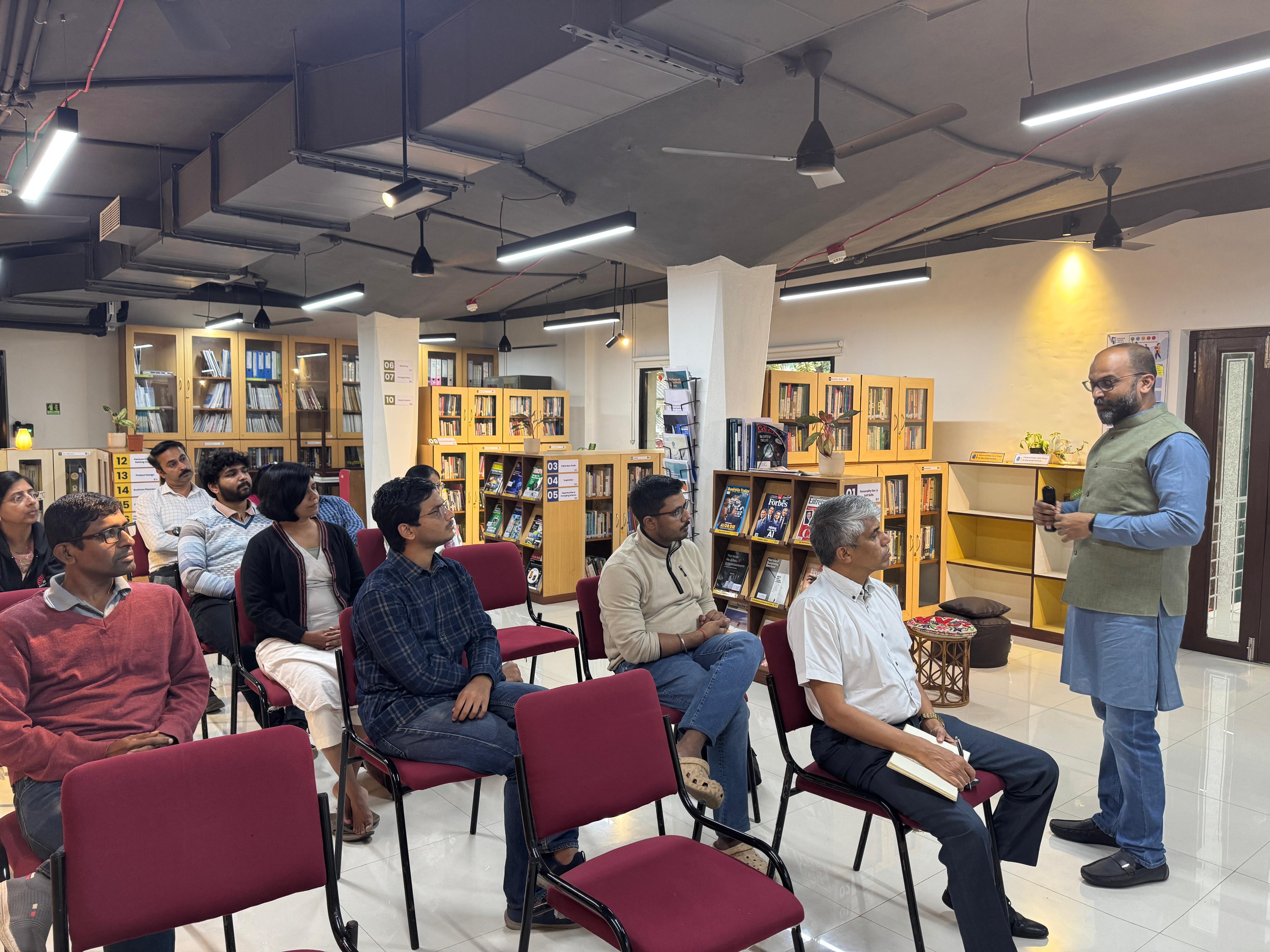
Jagdish guided the group toward that understanding. He grounded the discussion in real habits, real decisions, and real curiosity, allowing the abstract to feel practical without losing depth.

Looking Ahead
This Journal Club did not close a topic; it opened a direction. AI is already intertwined with how we think, work, and build. The task now is to engage with it intentionally — pairing its scale with our discernment, its speed with our judgment, and its intelligence with our intent.
Curiosity doesn’t pause—neither do we. At the Venture Center Library, where insight meets inquiry, the next Journal Club will push questions further and the conversation deeper. Become a member here.
You can join our WhatsApp community to stay updated here.